I recently finished a course on data privacy and we focused primarily on using differential privacy as a mathematically rigorous way to ensure that any individual’s privacy is not violated. As a conclusion to the course, we were to propose and complete a project that utilized differential privacy. Most of the class focused on using global differential privacy model, where individuals’ raw data is stored on a centralized server, and any analyst wishing to use this data must pass differentially-private queries to the server and receives noisy results. One potential problem with global differential privacy is that there is a burden on the individual to trust the data holder not to use the raw data. Local differential privacy, on the other hand, provides an additional security guarantee by never storing raw data and adding noise to the data before it is stored within the database. The tradeoff here is that the local model’s accuracy is typically orders of magnitude lower than the global model’s for a given query. While the accuracy is typically much worse, we still value the importance of the security guarantee which the local model offers. We set out to see how feasible it is to train a machine learning model by using differentially-private data through the local model. We satisfy the requirements of the local model by making each input example differentially private before our model sees them at all.
Dataset
We used the MNIST dataset which is comprised of images of handwritten numbers and their labels, the true number values. We originally planned on using both the images and their labels, but we quickly saw the problem with using noisy labels. If the label is incorrect, the entire example is driving the model in a completely wrong direction. Insetad we decided to use an unsupervised clustering method which ignores the labels entirely.
Models
First, we attempted to train our own convolutional neural networks which have been shown to be effective classifiers. After these results were not at all promising, we looked at current literature to see if any other methods would be more effective. We found a paper which described and implemented a model called invariant information clustering which is a state-of-the-art method for unsupervised image classification. This paper by Ji et al. even used the standard version of the MNIST dataset and achieved incredibly high accuracy of 99.2% correct classification rate, so we reasoned that it should still be able to achieve decent performance if we add noise to the data.
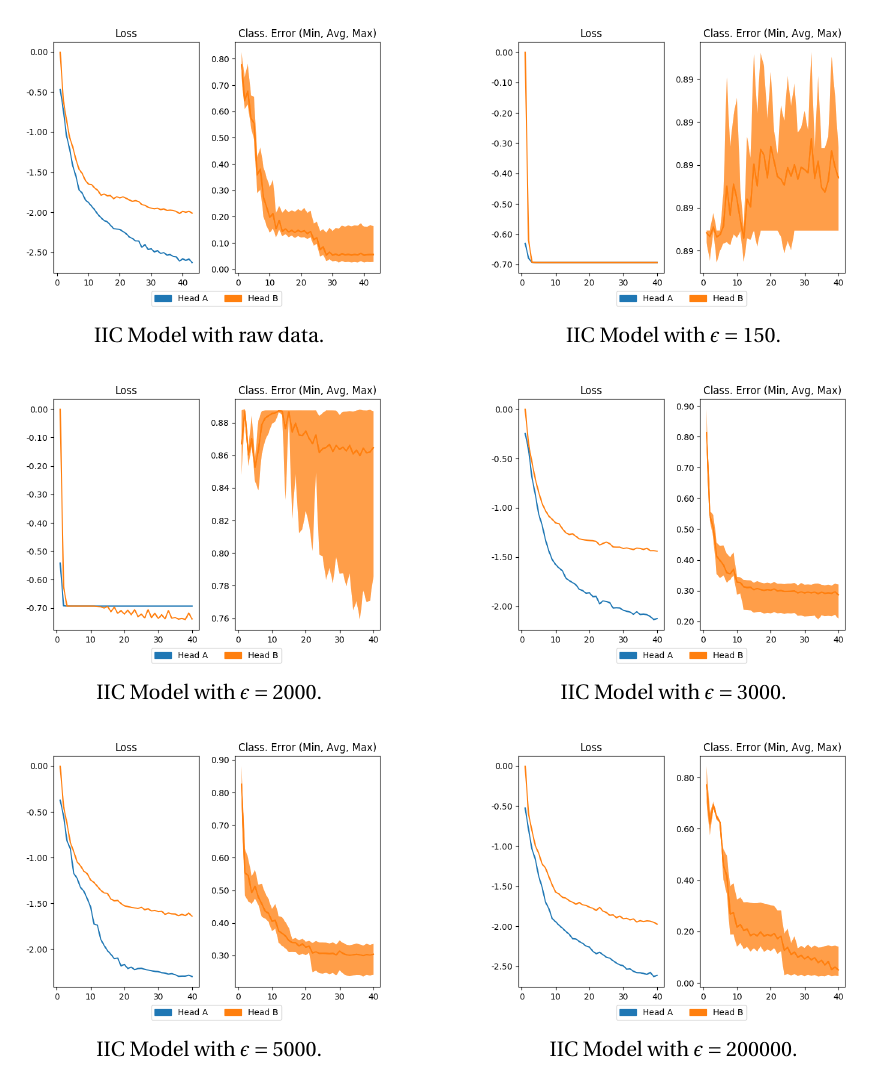
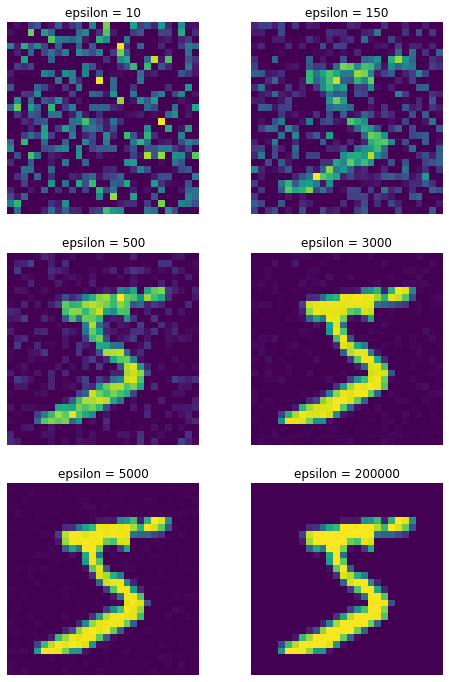
To generate the noisy input data, we first took the 28x28 image and normalized the pixel values so that the L2 norm of all the pixel values is 1. We then added Gaussian noise using the Gaussian mechanism to the data, with parameter values of sensitivity = 1, $\epsilon \in {150, 2000, 3000, 5000, 200000}$, and $\delta = 1/(28 \cdot 28)^2$ (i.e., $1/n^2$ ). The model then builds a neural network classifier from the noisy input data and the labels. The model works by taking an input dataset and then applying an image transformations like rotation and cropping- this is what makes the model invariant. At this point, both datasets are run through an unsupervised CNN and then a fully connected neural network to learn the natural clusters within the data. Because these labels are being generated without knowing the true labels, they are private. Results of this noising method for various values of epsilon are shown below. Note that these are all extremely high values of epsilon, and typically people consider values of $\epsilon=10$ to be revealing a significant amount of data.
Results
As expected, the model trained on the raw data performs extremely well and achieves a classification error of under 10 percent, with the loss dropping down to below -2.5. However, as noise is added to the images, the performance immediately and dramatically decreases. Initially, with an epsilon of 150 which seemed reasonable (see noised examples above) we can see that the loss bottoms out at -0.7 and the classification error never drops below 0.89. This is the proportion of examples in the plurality class which reflects that the model is completely failing to learn the data.
To summarize, we see that with an epsilon of 150 and 2000, the model is just picking up the plurality class. An epsilon of 3000 does better; however, still not as good as the model trained on the raw data. An epsilon value of 5000 surprisingly performs worse than an epsilon value of 3000, and this could be just due to the random initializations. An epsilon value of 200000 performs well; however, this case effectively adds no noise to the data. We found the magnitude of epsilon that we had to hit just to see improvements in our results to be very surprising and disappointing.
The repository for this project which contains the full paper, code, and slides can be found here